Fold to the Moon
More games

Fold to the Moon
PlayableOne sheet of paper. One very bad sense of scale.
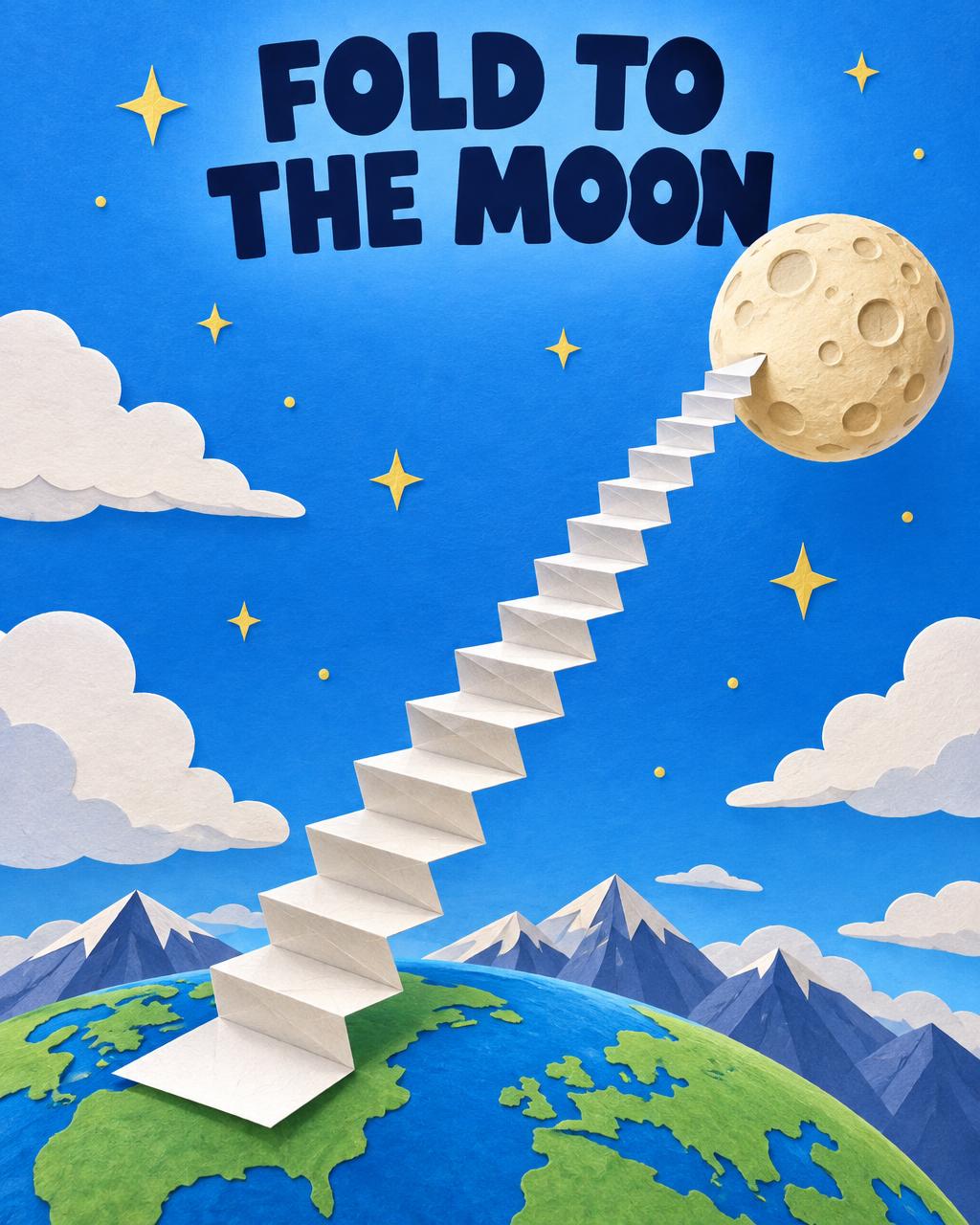
Fold to the Moon is a free interactive paper folding simulator about a number that feels wrong even after you have seen the math. Start with a sheet of paper just 0.1 mm thick. Guess how many times you would need to fold it in half to reach the Moon, then fold it one step at a time and find out.
Each fold doubles the thickness. The first few barely seem to change anything. Keep going, and your stack grows past everyday objects, buildings and mountains. The view pulls back as folded-paper figures put each new height into perspective. Eventually, a sheet of A4 becomes a very unreasonable way to travel through space.
This paper folding game turns exponential growth into something you can watch rather than just calculate. Your original guess stays on screen as the scale changes. Reach the Moon to see how close your prediction was, then keep folding toward the edge of the observable universe. No download or signup needed.
How to play
Choose one of the suggested guesses or enter your own number of folds. Press Let's fold and find out to start with a single sheet.
Tap the fold button, click an empty part of the scene or press Space to fold once. Each step doubles the stack's thickness and layer count. Watch the changing scale and the comparisons beside the paper.
At fold 42, the game pauses to show the Moon result and compare it with your guess. Choose Keep folding to continue all the way to fold 103, or Guess again to return to the beginning. You can turn the paper sounds off at any time.
How many folds of paper does it take to reach the Moon?
With a starting thickness of 0.1 mm, it takes 42 theoretical folds to exceed the Moon's average distance from Earth. After 41 folds, the paper would be about 219,902 km thick. One more fold doubles that to about 439,805 km, beyond the Moon's average distance of roughly 384,400 km.
The calculation is simple: thickness after n folds = 0.1 mm × 2ⁿ. The surprising part is how quickly repeated doubling catches up with an enormous distance. This simulator uses that idealized calculation; it does not model the force, sheet size or material limits needed to fold real paper.
From a sheet of paper to Mount Everest and beyond
- 10 folds: about 10.2 cm thick — still small enough to picture on your desk.
- 14 folds: about 1.64 m — around the height of a person.
- 27 folds: about 13.4 km — higher than Mount Everest.
- 30 folds: about 107 km — beyond the 100 km Kármán line commonly used as the boundary of space.
- 42 folds: about 439,805 km — farther than the Moon's average distance.
- 103 folds: about 107 billion light-years — greater than the roughly 93-billion-light-year diameter of the observable universe.
Why exponential growth is so hard to guess
Adding another sheet gives you a steady increase. Doubling the whole stack gives you an accelerating one. The difference is easy to miss when the starting number is tiny: after seven folds, 0.1 mm has only become 1.28 cm. But the same rule keeps working when the stack is kilometres tall.
Making a guess before you start lets you compare your intuition with the result. There is no timer and no penalty for being wildly off. It is a quiet little visual experiment about how far a very ordinary rule can take you.
FAQ
Can you really fold paper to the Moon?
No. The 42-fold result is a mathematical thought experiment assuming thickness doubles with every fold. A real sheet runs out of usable area and becomes too stiff to keep folding long before that.
Why does the simulator use 42 folds?
Starting at 0.1 mm, 41 doublings produce about 219,902 km of thickness, short of the Moon's average distance. At 42 doublings, the thickness is about 439,805 km, which exceeds that distance.
How many times can you fold a piece of paper?
There is no single limit for every sheet. Around seven folds is a familiar practical limit for ordinary paper folded by hand, but larger, thinner or specially prepared sheets can go further. This game explores theoretical doubling, not a physical folding record.
Does the starting paper thickness matter?
Yes. The result is the starting thickness multiplied by 2 for every fold. This game fixes the starting thickness at 0.1 mm; thicker or thinner paper would change when each distance is reached.
Can I keep folding after reaching the Moon?
Yes. Choose Keep folding on the Moon result screen. The experience continues to fold 103, when the theoretical thickness exceeds the diameter of the observable universe.
Is Fold to the Moon free and playable on mobile?
Yes. Play free in your browser without an account. Tap to fold on a phone or use your mouse or Space key on desktop.
An idealized visualization of exponential growth, not a simulation of physically possible paper folding. Distances are approximate, and the Moon's actual distance varies over its orbit.