Choose your next adventure
Lucky Guess
Lucky Guess
PlayableYou can cheat and nobody will ever know. Will you?
Based on Inspired by Martuza et al. (2026), Journal of Experimental Social Psychology — showing people consistently overestimate how much others lie and cheat.. More psychology games
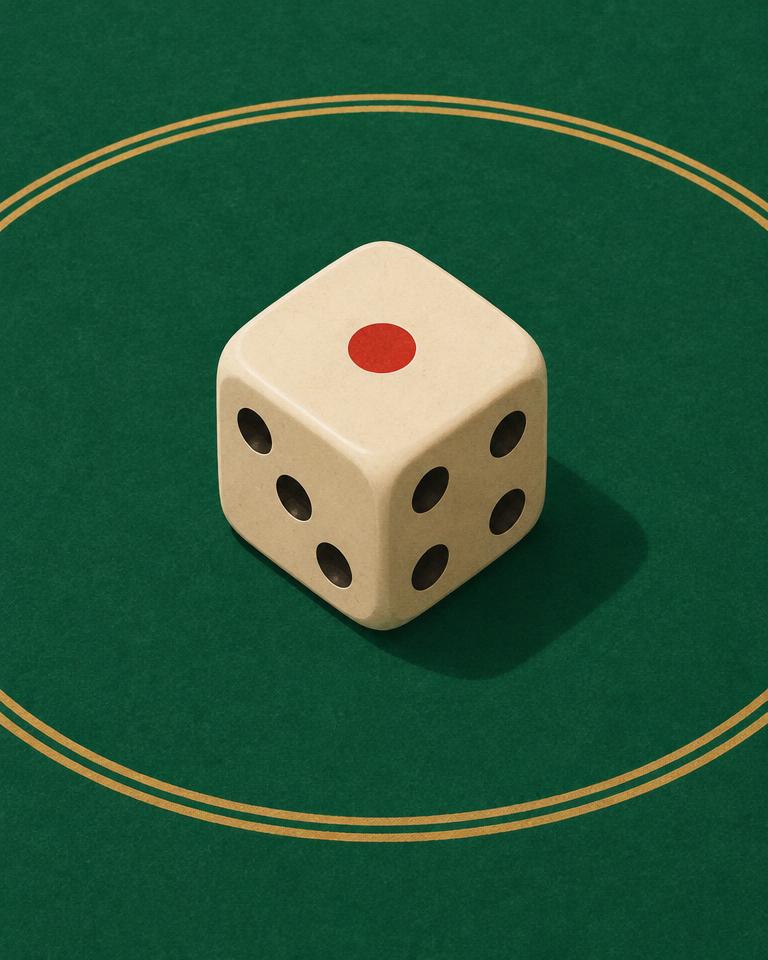
Lucky Guess is a short, playable honesty experiment modeled on classic die-roll cheating tasks in behavioral economics and social psychology. First, you predict what percent of players will cheat when there is no way to get caught. Then you play ten rounds: think of a number from 1 to 6 in your head, roll the die, and report whether you guessed right.
Because your guess stays in your head, nobody can tell whether any single player bent the truth. Across many players, though, pure chance sits at 16.7% (about 1.7 right out of 10), so the gap above chance reveals how much dishonesty happens in the crowd.
Across large studies, people routinely expect far more cheating than actually occurs. If you enjoy psychology experiments that test human nature, try How Bad Is It, Eye Duel or Gut Check.
How to play
Use the slider to predict what percentage of players will cheat when nobody can catch them.
In each of the 10 rounds, silently pick a number from 1 to 6, roll the die, and tap Yes or No.
At the end, compare your score, your prediction and the research findings on how honest people really are.
Why I created this
Most of us walk around assuming other people will cheat the moment nobody is looking. I wanted to turn that finding into a quiet, tempting 2-minute dice table where you feel the pull yourself, and test whether showing a leaderboard nudges people to bend the rules.
FAQ
Can Lucky Guess tell if I cheated?
No. Your guess is never typed in, so it is impossible to know whether any individual player lied. Only the anonymous group average compared to the 16.7% chance baseline shows how much cheating happens overall.
What study is Lucky Guess based on?
It is inspired by Martuza et al. (2026) in the Journal of Experimental Social Psychology, which found that people consistently overestimate how much others lie and cheat when given an undetectable opportunity.
Why did some players see a leaderboard and others did not?
Lucky Guess runs an anonymous A/B experiment: half of players see a leaderboard while rolling and half do not, to test whether social competition increases reported lucky guesses.